Thursday, April 30, 2009

Wombat.


These guys fall into the grand category of Australian (and Tasmanian) marsupials. Though often referred to, surprisingly not a lot of people know what they look like. So here the are.
Also, to give you a sense of size, they're typically about a meter long and usually between 40 and 80 pounds in weight.

Their defense is ridiculous -- when chased by dingos or Tasmanian devils, they dive into a tunnel. With just its butt sticking near the surface, predators have a hard time gripping them since their hide is tough and they don't have a significant tail to grab onto. If determined, it'll let the predator move its head over its back in the tunnel, and use its strong feet to push up and crush the skull of the predator between its back and the roof of the tunnel.

Also, their poop is very fibrous and is used to make eco-friendly paper these days. And finally, a group of them is called a "Wisdom."

Wednesday, April 29, 2009

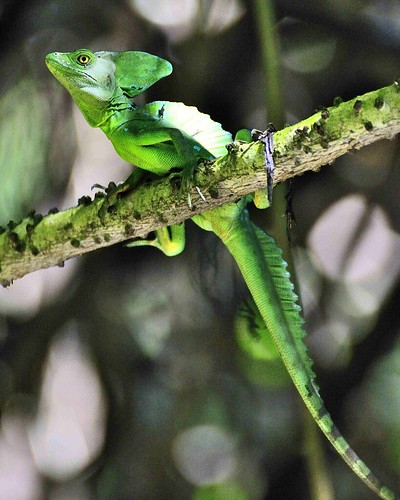
Jesus Christ Lizard.

Once you watch the video, you'll get the name.
You find them between Panama and Venezuela in thick forests.


Their ability to run on water is a unique defense technique. They have webbed feet (think frogs) allowing them to run on water if their momentum is high enough.

Tuesday, April 28, 2009

Leafy Sea Dragon.


The leafy sea dragon, as you can guess, is related to sea horses. They live off the coast of western Australia. And unlike my last post, these are abundant. So no worries here. They are leafy in look for camouflage not only in shape, but also in movement. The appendages floating around floats in the same way seaweed does, so often times you can't tell them apart. On top of that, depending on their diet and level of stress, they can change colors, too. Camo: CHECK.


Monday, April 27, 2009

Javan Rhinoceros.


This Rhino does not have great pictures that go along with it. Why? There are an estimated 50 left in the wild. Making it easily one of the rarest known animals. The related species is the Indian Rhino which is doing slightly better. There is known population in Mongolia and their threat, of course, is people. It's horn is often used for chinese medicine and its habitat, is of course, in decline.

Most of their behaviors are similar to their African counter-parts. The main difference is having 1 horn instead of two. It's less aggressive, and I guess lost the horn since it is costly to produce if it doesn't use it much.

Friday, April 24, 2009

Blue Poison Dart Frog.


Outsides of birds and fish, this is one of the few animals in the world that has blue coloration. As the name suggests, it is toxic -- although couldn't really do much damage to people.

They're found in Brazil & Suriname and have relatively unique mating patterns; the male sits on a rock, and calls when raining. The females find the male, and fight over the male. The 'winner' is taken to a secluded, quiet area for mating and laying eggs. Most of the time, the male watches over the eggs -- though there is a rotation. Unfortunately, they're a bit rare these days. Fortunately, they're on the upswing and zoos are successfully finding ways to reintroduce them into the wild.

Thursday, April 23, 2009

Long-Tailed Widowbird.


The long-tailed widowbird is from Eastern and Southern Africa. They look strikingly similar to our "Red-winged" blackbird in the states, but aren't really related. Just convergent evolution. The big obvious difference: the long tail. Only the males have them -- supposedly its only functionality is to attract a mate. It makes it an easier target to prey, but also makes it that much more impressive if it can pull off escaping. Putting itself in harms way only to escape? Go big or go home*, they might say. And the females agree.

*die.

The top picture is of a female, followed by a non-breeding male, followed by two pictures of breeding males.

Wednesday, April 22, 2009

Striped Pipefish.


I've always liked pipefish. They're very closely related to sea horses. It may not resemble them at first, but it's essentially a flattened out version of it. You have to look at its snout and its fins to really see the similarities. Behaviorally, they share the same unique characteristics, too; the males carry the eggs, and their babies, when hatched, look like a miniature version of the adult. Not all are this colorful, and as you can imagine the more colorful ones are ones nearer coral reefs in the tropics.

Also, if you're in the Chesapeake Bay area, it's very easy to find them. Depending on where along the coast you are, just take out a seine net and you're likely to catch at least a few (note: they're solid brown / grey in the Chesapeake).