Wednesday, May 20, 2009

Spanish Shawl.


Yep, another nudi. This nudibranch or "sea slug", Flabellina iodinea, is from off the coast of southern California. It is also one of the few nudibranchs that has a common name; most are just known by their scientific name. It is very similar in behavior to the Nembrotha kubaryana, a nudibranch I posted last month. The rhinophores (highlighted in the last picture) are used to detect odors. This particular species has red coloration in them from the pigment of their prey -- much like how flamingos are pink because of the krill they eat.

The tentacles on their body help them camouflage into coral and anemone but also help them sense their surroundings and trick predators into thinking their are poisonous.

Tuesday, May 19, 2009

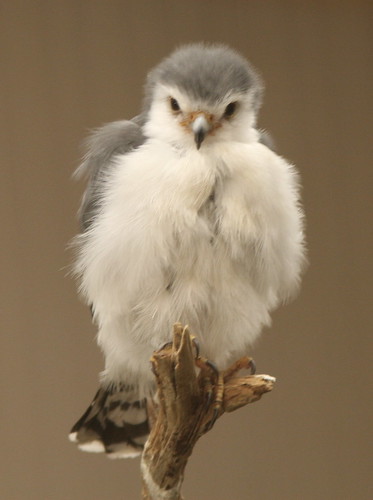
Pygmy Falcon.


The African Pygmy Falcon may look friendly, but trust me, they're not! They'll eat small insects (as opposed to large ones?), small reptiles and sometimes even small mammals. At only 20 cm long, that's a pretty impressive catch. Sometimes when desperate, they'll eat the chicks of other birds and when even more desperate, they'll go for adult sociable weavers (a bird about the same size).

They are often polyandrous (several males, 1 female). This is to keep warmth and sometimes a way for the females to ensure plenty of resources for the chicks -- if each copulated with the female, each might stay with the female and bring food to the chicks with the chance that the chicks are theirs -- no falcon paternity tests available for them!

Also, they don't build their own nests. They typically take over buffalo weaver nests -- the white-headed species in E. Africa and the red-headed species in S. Africa. In S. Africa you can also find them in sociable weaver nests -- which live in a large nest colony. So sometimes they will take over a chamber and live amongst other sociable weavers. Remember: They sometimes eat sociable weavers. As long as the weavers live in a place with a lot of food, they are safe. If not; doomsday pending.

Although, no matter how tough they are relative to their size, I can't really get over how cute they are. Sometimes they puff out their wings to look intimidating -- but compared to other birds of prey, it just looks like its trying to hard.

Monday, May 18, 2009

Lar Gibbon.


The lar gibbon, also known as the white-handed gibbon, is a part of the lesser apes group (The great apes being chimps, bonobos, gorillas, orangutan and humans). Though they are apes, they have more similarities to monkeys than other apes, and are significantly smaller in size than the great apes.

They live in SE Asia (China, Thailand, Myanmar, Malaysia) and are in decreasing numbers. Reason: Deforestation. They are almost entirely arboreal and its preferred mode of travel is swinging from trees. As you can guess, losing these trees would make it tricky for these primates to swing around.

There are two things in particular that I really like about them.
1. When they walk, they use their extremely long arms as a balance bar. They walk on branches very high off the ground, so it's certainly useful. The last picture is one walking -- I couldn't find a good one of it walking high off the ground.

2. They duet with their mating partners. Gibbons are known to sing and sometimes do it solo to protect territory - their call can be heard up to a full kilometer away from the point of origin. When with their partner, it is used as a courtship display to attract the mate but also ward off any potential competition. The duets are often complex with specific parts the males sing that the females counteract with -- it's pretty fascinating.

I will post a video of the duet later this evening -- I don't want to turn up my volume at work so I want to make sure that if I post it, the duet is clear. In the meantime, if you search for gibbon duets, you will surely find something.

Thursday, May 14, 2009

Small Leaf Katydid.


Katydids are all over the world. Sometimes they look like grasshoppers, sometimes they look like ants, and sometimes they look like bees. This one looks like a leaf! Mimicry is their thing.
As you can see, this species not only looks like a decaying leaf, but it can have different shapes of leaves for its body, too! As I'm sure you can guess, they hide well in..... water! (kidding.)

I'm sure I'll post more of these in the future -- some of them are crazy.


Flying Fox.


Flying foxes are a genus with several species -- all in the bat family. You might know them better as fruit bats. I have been asked before "do fruit bats ever bite people?" Yes and no. They probably could. They do have mouth and teeth. But their diet is pretty strictly pollen, fruit, nectar... that sort of thing. So you're safe. Unless you're filled with nectar.

So while people are frightened by bats, these bats aren't so bad. They're just tryin' to get by just like you and me.

Also, unlike other types of bats, these bats do not use echolocation. They have good visual and aural sensing abilities and can rely on that. Since the things they eat aren't found in caves, there is significantly more light in these bats environments. You can find them in the tropics and sub-tropics in places like India, Australia, China, Indonesia and some islands in the Pacific.

Wednesday, May 13, 2009

Dumbo Octopus.


Yes, this is named after Dumbo the Elephant. It's got 2 big fins that look like elephant ears to help it move through the water -- making it look like it's flapping its wings like Dumbo to fly!

They are deep ocean octopuses and are found at depths of over a 1 mile. Which is why, unlike other octopus species, they lack color most of the time. No need for it when nothing can see you anyway.

Here's an HD video of one swimming around. And somebody thought it'd be cool to pretend like it's a ballet, so please excuse that tackiness.


Satanic Leaf-Tailed Gecko.


I'll admit, this one's a little freaky. Still, very cool. They are endemic to Madagascar and are sometimes called the "fantastic leaf-tailed gecko" or the "eyelash leaf-tailed gecko."

As you can see from the 2nd picture - they come in a variety of shades and have incredible camouflage. To the point that sometimes even the leaf-shaped tail has veins to look even more like a decaying leaf. It's surprisingly also one of the most threatened illegally traded animals in the world. So, don't buy one if you see it. You'll know it might be one because you'll have to buy them in a black market. At which point you might figure most purchases might not be legal and sketchy at best.