Showing posts with label Birds. Show all posts

Monday, July 27, 2009

Satin Bowerbird.


There is a lot to say about bowerbirds. These Australian birds have perhaps the most complicated courtship ritual of any bird species. If new to you, it might also call into question your conception of art and creativity in humans.

Bowerbirds (male = picture 1, female = picture 2) build bowers (picture 3). Well, just the males do. Bowers are structures made from sticks, flower stems, rope... whatever is around. These structures form either dens or u-shape structures, and are not actually nests. Their only purpose is for mating displays. While most birds use feathers, calls and dances to attract females, this one adds an extra layer; design. Each species of bowerbird forms different shapes, but each individual designs their bower differently. They find objects from their surroundings (or steal them from other bowers) to decorate their bower. This can be by texture, color, shapes, you name it. And are arranged carefully to the point that it looks intentional. An individual's design might attract an individual type of female.

What's even more peculiar is that the females visit the bowers before seeing the males. They choose which they prefer, then later comes to the site when it is further to completion -- some decisions about the mate have been made entirely on the bower. Then the female returns when the male does calls, displays, etc. It is thought that this bird is especially unique because its physical attributes may be negated by its creations. So if it has bad feathers, it might be able to make up for that by having an exceptional display, or a refined call. Other birds can't do that -- they've just got to flaunt what they've got.

But why wouldn't the female use color to assess its mate? That seems to be the case in other bird species, and it can be telling of a birds health. In this case, the creativity in a bower might suggest its ability to acquire goods and hold territory better than other males; a valuable ability for sure.

The bower's functionality itself is still not entirely clear. The satin bowerbird's structure is somewhat understandable, in that it is essentially a contraption... during copulation, a female walking through the bower might not be able to fly away, since its wings cannot spread. This isn't the case for all bowerbirds though. And before you think this forced copulation seems aggressive, keep in mind that the female has chosen an individual based on the bower long before visiting the site and sometimes visits multiple times to hear its call and watch his display as well. So it seems the female has to let copulation occur -- maybe the structure is a remnant of a behavior its ancestor had when perhaps forced copulation was the norm? Who knows.

So why does this call into question our sense of art and creativity?
We often think most animals work mechanically, with the exception of us. They just "do" things and don't think about it. There's no control over its actions.

This might still be the case with this bird -- it might be a natural preference and each bird might have a gene that makes it get one color over another, or one shape over another. But the point is each is different and each artful display holds no functional value other than impressing the other sex (the fruits, flowers, seeds, shells, etc are never used for feeding, protection or health). Though we don't label our art quite so directly, when we do similar things, we say it's not to attract others (because that's what's favorable to others) and we say it comes from creativity that involves individuals thought. And we convince ourselves of this.

It's not to say we don't have individual preferences that require thought or creativity, but how are we any different than this species in that regard? Either our creativity is innate for validation or attraction or these birds have significantly more thought than we would like to think and don't give them credit. When we study other animals, it seems obvious that it's the first option and it seems like we just say that can't be the case for us because it makes us feel better and... uh-oh.... validate our creativity.

Regardless of your thoughts, it's an incredible display and I personally think it applies to people very well.

Here's a video feature the wonderful David Attenborough:


Tuesday, July 21, 2009

Indian Peafowl.


You probably know them as 'peacocks.' Which would be halfway right... they're actually peafowls... peacocks are just the male counterpart (when you think about it, it makes sense). And the female is called, you guessed it, a peahen.

Before I get to anything else, I'd like to point out that oddly, this is one of the few national birds that is sex-specific. India specifically has the peacock as the bird, not the peafowl. So the national bird isn't even the full species. Strange. Perhaps because the peahen is not quit so pleasant on the eyes (picture 2), at least in comparison to the peacock (picture 1).

So on to the bird. It's obvious why everyone can recognize one -- they're large, showy and have beautiful colors. Which all fits into the the insight they offer to evolutionary theory. Why would a bird need to be that colorful and over-the-top? The ladies are choosy. It may seem like an abritrary guideline to pick based on looks, but its very telling about the mate. The larger the feathers, the more vulnerable the peacock is to predators and the harder it is for them to mobilize. So if one can survive to adulthood with larger and more colorful feathers than another, this means that its able to compensate for its handicaps, or else it wouldn't be alive. It can also tell a female how healthy a male is -- unhealthy males will have dull colors. It should be noted that their feathers are irredescent, meaning they reflect diffferent colors based on lighting, which is pretty awesome.

What I find most fascinating is the relationship between the display and its immune system. Its very relatable to human behaviors:

The larger feathers, stronger colors and more active displays all require more testosterone than one without those attributes. More testosterone = weaker immune system. So how is this good? Like surviving against predators, it signifies to the female that though it weakens their immune system, their baseline health is better than others, or else the weaker immune system would weaken its chance of survival or their ability to compete. One with less testosterone doing the same display might have duller colors or die before maturity.

So the lesson is: looks do matter. Though it seems superficial, animals prefer certain looks over another because certain looks are associated with better health, better ability to hunt or provide for offspring, or any other set of criteria. Appearance is the culimination of all these things. Which explains why we as people tend to be largely attracted to the same types of features -- they might provide insight into their health or ability to provide, even if we don't conscientiously think about it in those terms. And no, I'm not saying we should use looks to base relationships because I think we define 'success' for ourselves and offspring as something else. And we have medical assistance to counter health problems, so it may not always necessarily be the most important to find someone who is naturally as healthy since we all depend on medical developments to counter shortcomings.

This is me rambling a little bit, but I think it's a good demonstration of the types of decisions people make and is a nice reminder of how we are animals and not in a totally separate set of rules. People who spend more money on cars, houses or whatever are telling others they can spend their money while still being able to have enough to provide for whoever it is they are trying to attract. A honda and a ferrari have the same function but one tells you more about the types of resources they have to 'waste.' I'm not saying its shallow or inappropriate. In fact I think I'm saying that there is evolutionary logic in explaining that behavior and that it's the same as we see in other animals, like peafowls.

Oh yea, and they have really annoying screams, so if you're ever in a place where there are a lot of peacocks, prepare to not sleep, they wine all night.

Thursday, July 16, 2009

Black Skimmer.


Black Skimmers can be found all along the Americas. They breed in the northern hemisphere, and migrate down to the south during fall and winter.

As you can guess from the pictures, I would hope, they are named for their behavior of skimming for fish. They have a large lower mandible (see last picture) that drags in the water. When it hits something, it flinches its neck down and closes its beak, hoping to catch something.

What's nice about it is, from an observation perspective, a lot of animals are hard to see performing certain behaviors. These, however, are pretty much seen always doing this, so it's fun to watch.

If you ever get a chance, take a boat out on the Atlantic coast of the Eastern Shore and watch them go to town.

Monday, July 13, 2009

Superb Lyre Bird.


This bird is one of the largest known passerine birds (songbirds) on the planet. And these native Australian birds are easily the champions of this avian category. While all birds have unique calls, this one goes above and beyond. Like a mockingbird, it can perform calls of other birds it might hear over the course of its lifetime. What's so unique about the lyre bird is that they mimic almost any sound it hears, not just birds. The larger the repertoire, the more impressive it is to a female. It's also telling of its lifetime experience, which is interesting from a research perspective. From its calls, you can tell how much interaction they've had with humans -- for example, they'll pick up sounds of bulldozers, chainsaws, cameras, car horns, you name it.

They are called "Lyre" birds because of their tail feather structure -- the ends curl out and form the shape of a musical lyre.

It also has awesome tailfeathers to shake around to impress the ladies.

Here's a video, featuring the one and only, David Attenborough.


Tuesday, June 30, 2009

Red-Capped Manakin.


Everyone seems to be tributing Michael Jackson these days, so I thought I'd hop on board, Animal of the Day style. You might think, what does this bird have to do with Michael Jackson? I'll get to that.

First, this animal is pretty common in C. America (specifically its forests) and doesn't do well around people -- they're pretty fragile birds in a pretty fragile ecosystem. But their population is going strong.

Second, its the only bird able to beat its wings faster than a hummingbird. It doesn't do this while flying, so the hummingbird still carries its own with how fast they can beat their wings to keep themselves afloat. These things just do it as a mating call (the sound it makes when they beat them together really quickly). As you can see, they're sexually dimorphic - the female doesn't look very much like the male (male = top 2 pictures, female = bottom). This goes to show how many birds are named as well -- after the male counterpart, when there is dimorphism. At least we recognize the male better, on average (Did you ever think why we refer to 'peacocks' as 'peacocks' and not 'peafowl'? There are peahens, too, you know...).

Anyway, the real reason I posted this. Its relation to MJ. It has a wonderful mating dance, which will be evident from this tacky video. I wish you could easily take out the clips of the ornithologist dancing around, too, because she is incredibly annoying, but sit through her to watch it, it'll be worth it.


Wednesday, June 24, 2009

Rock Dove.


As you can tell, pigeons won the vote. So now comes my challenge in convincing you that they aren't boring. And... go.

OK, so these doves from a purely biological stance are unique in its mating in one particular way. They tend to be monogamous. In a weird way. They attempt to mate with others but stick around with whichever female best convinces the male it is his chicks he is caring for. It's not totally understood how they do it, but displays are likely the answer.

One thing, like it or not, is that they are sure to stick around. Unlike most animals that decline in population around people (because of interrupted or damaged ecosystems or corridors), this one seems to adapt. And adapt well. Though traditionally known to roost on rocks and cliffs (hence its name), it has transferred a sense of a 'cliff' to a building ledge. Similar topography. They also have stopped migration in most places, finding warmth in street vents and heat rising from roads. And because of that, its annual behaviors have become less defined. For example, they mate all year round, versus just specific times of the year. There might be peaks in spring and summer, but there is no significant definition of mating season for them.

Personally, I think this is kind of awesome. Sure they can be annoying and they are everywhere, but it's a reminder that wildlife is actually everywhere, and as much as we want to think of our urban environment as separate from an ecosystem, it's really not. It's just a terribly modified and typically inhospitable one for most species other than ourselves.

On a totally different note, they've also been helpful to people when domesticated. To the point of earning medals of honor during the World Wars. I'm not lying. You remember homing and carrier pigeons, right? They were bred to return home went sent somewhere else. Soldiers would attach messages to its leg and were sent off -- missions people couldn't do since no one is likely to waste a bullet on a pigeon. Not only that, they would use specific pigeons. Cher Ami of France won a prestigious award for heroic contributions to WWI. And the US awarded several pigeons awards during WWII. Homing pigeons have been used since about 1150 CE in Baghdad and were used by Genghis Kahn. Military posts would regularly be decorated with pigeon posts. And you might be familiar with the name "Paul Reuter" who founded the Reuters news agency? He used to deliver headlines in the 19th century using a fleet of piegons. Long story short, they can be credited for saving thousands of human lives and delivering news when headlines may not have been quite so accessible.

Moving to a similar subject, people throughout time have been intrigued by its breeding capabilities. Like dogs, pigeons were bred for specific functions or fanciful fulfillment. Some bred for unique colors, some for body shape and feather ornamentation, some for function (homing pigeons), and some I'm not really sure for what. Dozens of varieties exist, each with a unique cultural context. I've posted a few of them above.

There probably isn't too much terribly fascinating information for you in here, but I think they are a bit more unique and interesting from a human standpoint than one might typically think.

Monday, June 22, 2009

Gannets.


The Gannet family is broken into 3 species -- Northern Gannets, Cape Gannets and Australian Gannets (north atlantic, south africa and australia, respectively). There are a few shared traits about these birds, the first being their colonies. The last picture is actually a picture of thousands of nesting gannets (they always colonize rock cliffs). Chicks learn to fly by jumping off of these cliffs and flying before hopefully hitting the water, so obviously cliffs lend themselves to more injury if failed, but more time to figure out the whole flight thing before it crashes. And being seabirds, there aren't many other opportunities for land to still get the feed they prefer.

A social behavior of theirs that is unique is mating pairs. They pair for several seasons (but not for life) and each time greet each other by raising their bills and tapping them together, like in picture 2. They might remind you of emperor penquins.

Feeding: Perhaps the coolest, and you'll see why in a minute, is their eating behavior. Since they travel in flocks of thousands, it's a spectacle in itself, then add in the fact that they dive into the water at high speeds to catch fish underwater. It's built a relationship with other species also attacking the fish, like dolphins, sharks, etc. that create bait balls.

And now, let's blow your mind:

Finally, a reminder to submit your vote for an animal you think is boring but actually isn't.

Thursday, June 11, 2009

Grey Crowned Crane.


This bird can be found from pretty much Uganda to South Africa. It's not terribly uncommon, and it is the national bird of Uganda. They stand up to 3.3 feet tall and weigh about 8 lbs. I didn't really know about them until I went to E. Africa a few years ago -- these are some pictures I took.

There are a couple things striking about this bird:

1. It is one of only two crane species that roosts in trees. This is mainly so it doesn't fall prey to animals on the ground.

2. Its mating behavior. Cranes are known for its "Dance" which is essentially flapping its wings, jumping up and down, and bowing to the female. If done well, the female will mate.

This isn't a fantastic video, but from the first couple seconds, you get the idea:


Friday, May 22, 2009

Kakapo.


Kakapo! Kakapo! These parrots of New Zealand are unique as one of the few nocturnal parrots in the world and is the only flightless parrots in the world, they are are fascinating, indeed. Today I'll share a couple interesting facts about them...

First, they're evolutionary history. They supposedly spit from other parrot species when Gondwanaland broke from Pangea (supposedly Pangea spit into and land mass called Laurasia composed of what is now N. America / Europe / Asia in the North, and everything else fell into Gondwanaland). Anyway. In the break, ancestors of the Kakapo inhabited islands that were free of mammals and other potential predators. This led to their loss of flight -- they lost their need to escape quickly from most situations.

The second notable thing of them is a bit of bad news -- their status in the world. There are only 125 known living Kakapo; so few that most even have individual names so it's easy for scientists to reference. On top of that, they have been moved to new islands to protect them from predators; something controversial yet seems to be one of the few remaining options. This is especially unfortunate as it is clear they are important to the Maori people, as it's often a legendary bird in traditional storytelling.

From the pictures, you can see that their feathers are pretty wonderful, and their babies look like they could be muppets.

Tuesday, May 19, 2009

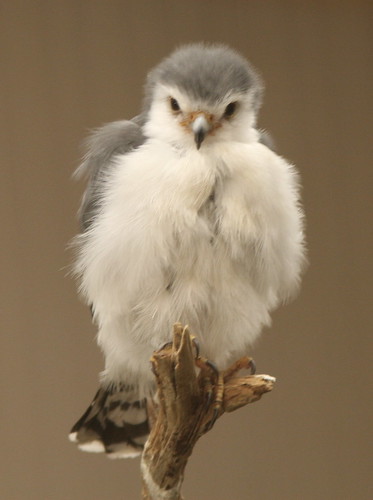
Pygmy Falcon.


The African Pygmy Falcon may look friendly, but trust me, they're not! They'll eat small insects (as opposed to large ones?), small reptiles and sometimes even small mammals. At only 20 cm long, that's a pretty impressive catch. Sometimes when desperate, they'll eat the chicks of other birds and when even more desperate, they'll go for adult sociable weavers (a bird about the same size).

They are often polyandrous (several males, 1 female). This is to keep warmth and sometimes a way for the females to ensure plenty of resources for the chicks -- if each copulated with the female, each might stay with the female and bring food to the chicks with the chance that the chicks are theirs -- no falcon paternity tests available for them!

Also, they don't build their own nests. They typically take over buffalo weaver nests -- the white-headed species in E. Africa and the red-headed species in S. Africa. In S. Africa you can also find them in sociable weaver nests -- which live in a large nest colony. So sometimes they will take over a chamber and live amongst other sociable weavers. Remember: They sometimes eat sociable weavers. As long as the weavers live in a place with a lot of food, they are safe. If not; doomsday pending.

Although, no matter how tough they are relative to their size, I can't really get over how cute they are. Sometimes they puff out their wings to look intimidating -- but compared to other birds of prey, it just looks like its trying to hard.

Tuesday, May 12, 2009

Hoatzin.


The Hoatzin of Northern S. America is a fun one for scientists.
People aren't really sure what these are related to, but they seem archaic in morphology which, if true, is a good glimpse of the evolution of some other living birds.

As both large and distinguished birds, its a surprise they are not threatened (good!) nor does it seem likely that they will be. Though many in the area eat larger birds or use feathers for various purposes, the Hoatzin is not ideal for it. Why? They smell terrible and apparently their eggs are revolting. So people only eat it when ABSOLUTELY necessary. Also, they live in mangrove and riparian forest systems -- significantly less threatened than other types of forests in Brazil.

Something interesting about them is they are born with a claw at the end of their wings. They are known to be clumsy, and these claws come in handy when young. Growing up in mangroves is not a safe environment -- all sorts of things wanting to eat chicks might show up, so to counteract bad balance, they can use their claws to climb onto branches or hang on for dear life.

Monday, May 4, 2009

Secretary Bird.

The Secretary Bird of Eastern and Southern Africa is often seen wandering through grasslands. This is a picture from my first encounter with one and it was described to me by someone else of having the name "secretary bird" for its "black business pants and secretary hair-do." Another hypothesis of the origins of the name: The name derived from the Arabic saqr-et-tair meaning "Hunter Bird." I'm gonna go with the former explanation.

Another cool thing -- for a long time people thought they were related to eagles because of its head shape, but the crane-like legs through people off. It's related to kites and vultures.

Other cool facts: They stand about 4 feet tall and roost in acacia trees overnight.

They are also on the Coat of Arms for Sudan and S. Africa.

Thursday, April 23, 2009

Long-Tailed Widowbird.


The long-tailed widowbird is from Eastern and Southern Africa. They look strikingly similar to our "Red-winged" blackbird in the states, but aren't really related. Just convergent evolution. The big obvious difference: the long tail. Only the males have them -- supposedly its only functionality is to attract a mate. It makes it an easier target to prey, but also makes it that much more impressive if it can pull off escaping. Putting itself in harms way only to escape? Go big or go home*, they might say. And the females agree.

*die.

The top picture is of a female, followed by a non-breeding male, followed by two pictures of breeding males.

Thursday, April 16, 2009

Greater Prarie Chicken.


These are ridiculous. Really. You find them in, well, praries. They have a very elaborate mating ritual. The males defend territory in Leks ( or "booming grounds"... see above) and display by "booming" (making loud, low-pitched sounds from air gathered into the orange air-sacs). Presumably, the more brightly colored and louder the boom, the better. Also, they stamp their feet and fly into each other for attention and more signs of the quality of male the female is mating with. There is also bowing that goes on.

Here's a video to drive the point home:


And to explain the lek idea more, as you can see the picture of a lek for a sage grouse above (though a different species, same concept), the placement serves as indicators of their status.